
article
Early Access Waitlist: How to Run the Program in Waves
An early access waitlist run properly: the beta, invite waves, and the exit criteria that tell you when to widen — with real programs to study.
You have a product that is nearly ready. You want real users in it, but not all at once — a controlled group first, so you can fix what breaks before the public sees it. That is an early access program.
Most early access programs run on a waitlist: people sign up before anything is live, and you invite them in waves. Here is how to run one end to end — the page, the queue, the invites, and when to open the doors.
The short answer
An early access program is a controlled release: people sign up before you are live, and you let them in waves instead of all at once. The tool that runs it is a waitlist — also called a beta waitlist — which collects signups and gives each person a queue position and a referral link. You get a demand signal, a queue, and a list you can email — instead of an open door that floods you with users you cannot support.
Why a waitlist instead of an open beta
Opening your beta to everyone sounds generous. In practice it causes three problems:
- No control. You cannot throttle load, support requests, or feedback volume.
- No signal. An open door tells you who showed up, not who wanted in.
- No list. If you collect nothing, you cannot invite more people later or announce your launch.
A waitlist fixes all three. It is a demand signal and a growth loop in one.
How to run an early-access waitlist
- Create the waitlist. One page, one field (email), a clear promise of what early access gets them.
- Publish it. Use a hosted page if you have no site yet, or embed the signup form on the site you already have. No code either way.
- Turn on referrals. Every subscriber gets a unique link, and referrals move them up the queue. This is what makes an early-access list grow itself.
- Confirm intent with double opt-in. Optional, but it keeps your list real and reduces spam signups.
- Invite in waves. Use email broadcasts to invite the first cohort, then the next. Each wave gets a warm welcome and a clear ask.
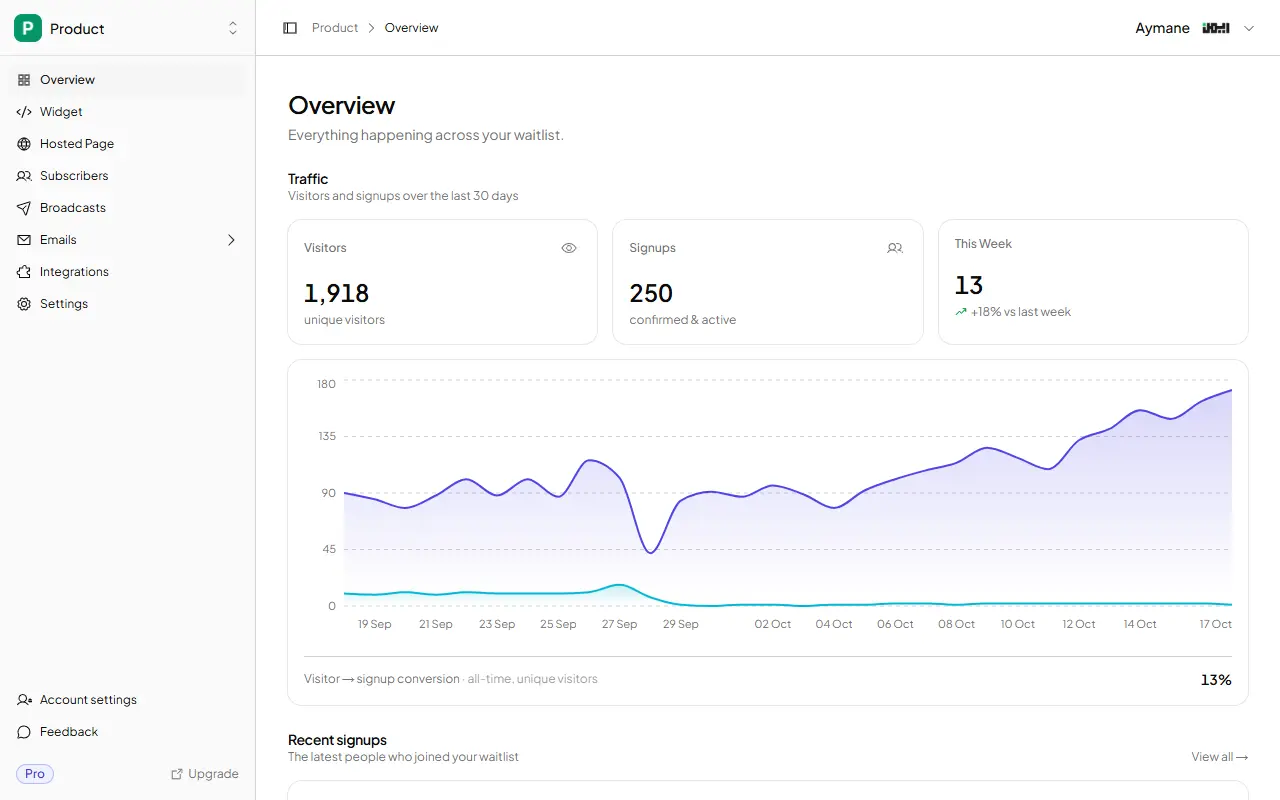
- Watch the numbers. Views, signups, and conversion rate tell you whether your messaging or your traffic is the bottleneck.
When to widen the wave
"Scale as your product holds up" is the standard advice and it is useless on its own. You need a rule you can check, or you will either stay too small for months or open the doors the moment you get impatient.
Pick your criteria before the wave starts, and widen only when all four hold:
| Check | What you are looking for |
|---|---|
| Activation | Most invited people complete the core action without you explaining it |
| Support load | You are not answering the same question for every new user |
| Bug rate | New issues are edge cases, not blockers — nothing that stops a first session |
| Feedback novelty | The new wave stops surprising you; you are hearing the same three things |
The last one is the signal most founders miss. When a wave of 25 produces no new information, you are no longer learning — you are just growing slowly, and it is time to widen. When it produces a genuinely new failure every day, adding more people multiplies the mess.
A practical cadence: 10–25 people in the first wave, then roughly double while the four checks hold. For what the numbers should look like along the way, see waitlist benchmarks.
Early access vs beta vs soft launch
These three get used interchangeably, but they answer different questions:
| Early access | Beta | Soft launch | |
|---|---|---|---|
| What it describes | Who gets in first | How finished the product is | How quietly you open |
| Who can use it | A chosen group, invited from your list | Testers, invited or open | A small group, widened in rounds |
| What you learn | Demand and willingness to join | Bugs and gaps | Whether it is ready for more people |
A waitlist is the tool underneath all three: it is where people sign up and where you hold the queue. A closed beta (often called a private beta) is invite-only; an open beta lets anyone in.
In practice they run as one flow: waitlist → early access invites → beta → soft launch → public launch.
Real early access programs worth studying
The pattern is older than the word. Three programs shaped how early access is run today:
Gmail (2004) launched invite-only, with existing users handing out a small number of invites. Each invite became a recommendation, and demand stayed visible while Google scaled. What to copy: let early users do the inviting, and give each a small, concrete number to hand out.
Clubhouse grew by invite-only access before opening up. Access was the reward, and the exclusivity was the product rather than a growth hack. What to copy: when the community is the value, gating entry is the offer, not a delay.
Superhuman stayed invite-only for years, onboarding users one at a time with a personal setup call. The product was nearly finished the whole time — the constraint was support capacity, not engineering. What to copy: treat invite-only as a quality-control lever, not scarcity marketing.
The common thread: none of them opened the doors because they were nervous. Each had a specific, named bottleneck — infrastructure, community value, support load. An early access program without a named constraint is just a launch with extra steps.
What to put on the page
Keep it short. Say what the product does, who it is for, and what "early access" actually gives them (a free month, a founding-member price, a say in the roadmap). Then one button.
The full checklist is in Waitlist Copywriting That Converts, and waitlist landing page examples and templates has copy-paste structure to start from.
Why referrals matter more for early access
An early-access list is full of people who want in first. That makes it the ideal place for a referral loop: giving someone a way to move up the queue is a reason to share, and sharing grows the list while you build. We break down the mechanics in the Pre-Launch Referral Program Guide.
FAQ
What is an early access waitlist?
A page where people sign up to get into your product before the public — often called a beta waitlist. You collect emails, then invite people in waves. It doubles as a demand signal and a launch list.
How is a waitlist different from a beta signup form?
Functionally similar, but a waitlist usually adds a queue and referrals, and is meant to run before the beta opens. A plain beta form just collects names with no growth loop.
Do I need a website for an early-access waitlist?
No. Publish a hosted page (no site required), or embed the form on a site you already have. Both take minutes and are free to start.
How many people should I invite per wave?
Start with 10–25. Enough to get real feedback, few enough to support them personally. Then scale each wave as your product holds up.
Is it free?
Yes. The free plan includes a hosted page, an embeddable widget, analytics, and up to 100 subscribers. Referrals, double opt-in, and broadcast emails start at $5/mo.
Related reading
- Mobile App Waitlist: The 4-Week Plan — the same flow for an app
- Waitlist Emails: The 5-Email Sequence — what to send your early-access list
- Should You Build Your Own Waitlist? — why not to build the backend yourself
- Waitlist Use Cases: What to Use a Waitlist For — every use case in one place
- Waitlist Glossary: 17 Terms Every Founder Should Know — queue position, early access, and the rest, defined
Run your beta like a launch — collect, queue, invite, repeat. Start your waitlist →

written by
Aymane E.
Founder of GetWaitly. I write about validating ideas, pre-launch, and growth from building a waitlist tool as a solo founder.
Follow on X