
article
Waitlist Glossary: 17 Terms Every Founder Should Know
17 waitlist terms in plain English — conversion rate, k-factor, viral loop, double opt-in, queue position, position inflation, referral fraud, and more.
Waitlist vocabulary gets thrown around like everyone already knows it — "turn on double opt-in," "watch your k-factor," "position inflation." If you are launching for the first time, that shorthand hides real decisions.
This glossary collects the 17 terms that actually come up when you build a pre-launch waitlist, defined in plain English. For each one, there is a link to the deeper guide if you want to go further.
A note on scope. "Waitlist" means different things in different queues. Airlines, colleges, restaurants, and ticketing platforms use the word for a list you join when capacity runs out. This page is only about the marketing waitlist — a signup list you build on purpose before launch, to measure demand and email people the day you open. If that is the waitlist meaning you came for, these are the terms you need. If you wanted the airline kind, this is not it.
Waitlist conversion rate
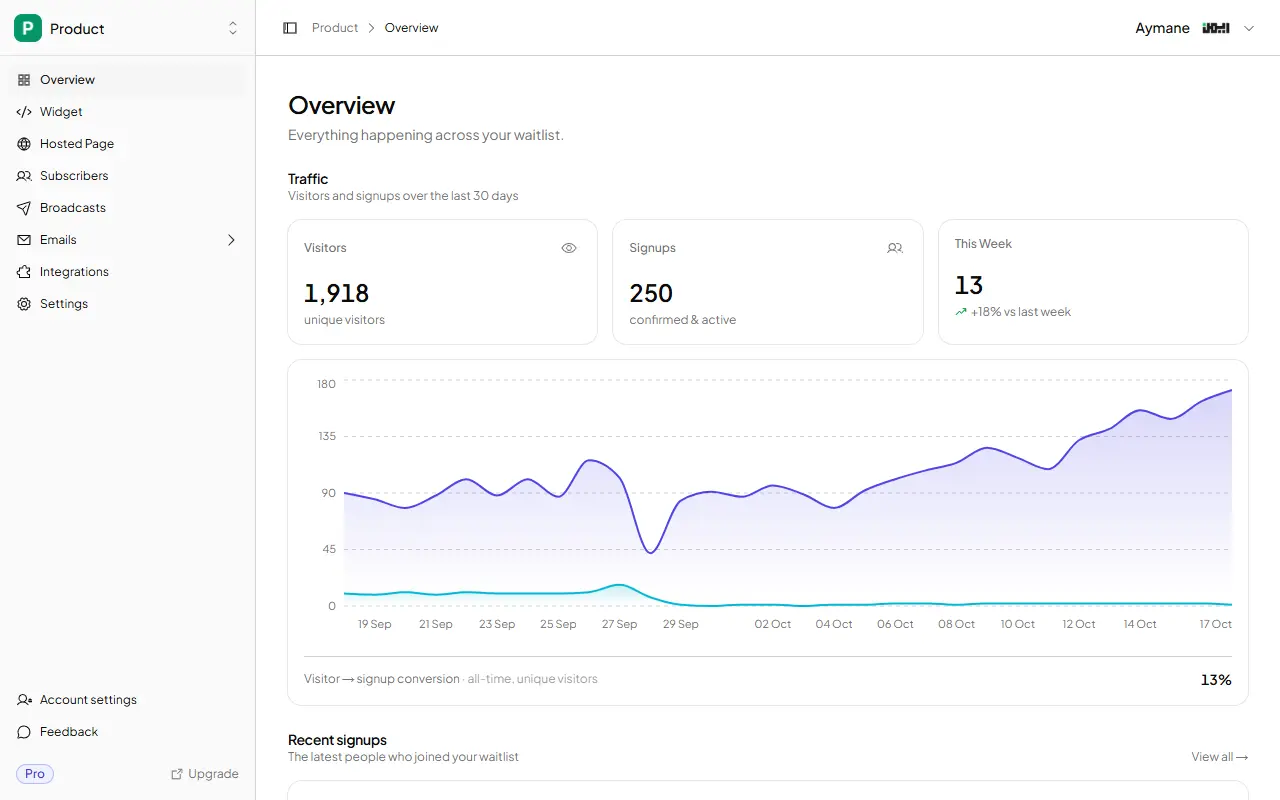
The percentage of people who view your waitlist page and actually sign up. It is calculated as signups ÷ visitors × 100. It is the single clearest signal of whether your page and offer connect: a high-traffic page that converts at 2% is usually a copy problem, not a traffic problem. Most landing pages convert in the single digits; a well-run waitlist can do better.
Related: Waitlist Copywriting that Converts and the waitlist benchmarks for realistic ranges.
Referral k-factor (viral coefficient)
A measure of how many new subscribers each existing subscriber brings in, on average. The formula is k = i × c, where i is the average number of invites a subscriber sends and c is the conversion rate of those invites. When k is above 1, each person more than replaces themselves and the list grows on its own; below 1, growth decays without new traffic.
Related: Pre-Launch Referral Program Guide.
Viral loop
The cycle that turns one signup into more signups: someone joins, gets a referral link, shares it, a friend joins, and the friend gets their own link. A viral loop is the mechanism; the k-factor is how well it performs. A waitlist with a referral queue is the simplest viral loop a founder can run.
Related: Pre-Launch Referral Program Guide.
Double opt-in
A signup flow where a new subscriber must click a confirmation link in an email before they count as confirmed. It reduces fake and mistyped addresses and protects sender reputation, at the cost of losing the people who never confirm. It is the safer default for a list you intend to email.
Related: Waitlist Email Templates.
Single opt-in
A signup flow where subscribers are added immediately, with no confirmation step. It captures more addresses but includes typos, bots, and people who did not really mean to join — which can hurt deliverability later. Fine for a low-stakes list, riskier before a launch email.
Related: Waitlist Email Templates.
Queue position
The place a subscriber holds in the waitlist line, usually shown on a personal status page. Position is what makes a waitlist feel like a waitlist rather than an email form — and it is the incentive that makes referrals work, because inviting friends can move you up.
Related: LaunchList vs GetWaitly covers position mechanics.
Position inflation
Deliberately starting new subscribers higher in the queue than they truly are, or compressing positions so everyone feels closer to the front. It is a psychological nudge that makes waiting feel shorter and sharing feel more rewarding. A tactic, not a deception — but use it honestly.
Related: Pre-Launch Referral Program Guide.
Queue jumping
Moving ahead in the waitlist by referring friends or completing actions, rather than by waiting. It is the reward half of a referral program: the queue provides scarcity, and jumping provides the reason to share. Without a queue, referral rewards feel arbitrary.
Related: Pre-Launch Referral Program Guide.
Referral leaderboard
A public or semi-public ranking of the subscribers who have referred the most people. It turns referrals into a light competition and gives your most active fans visible status. Leaderboards work best when the reward for the top spots is genuinely worth chasing.
Related: Pre-Launch Referral Program Guide.
Milestone rewards
Incentives unlocked at specific referral counts — "invite 3 friends, get early access." Milestones are more concrete than a leaderboard for most people, because the goal is reachable and the reward is certain. They are the simplest way to raise your referral rate.
Related: Pre-Launch Referral Program Guide.
Referral fraud
Signups built to game the reward ladder — one person opening several accounts to climb the queue faster, or a giveaway hunter farming referral credit they did not earn. Good systems detect it silently rather than blocking anyone: the signup still goes through, but it is flagged for the founder to review and the referrer's credit is withheld, so queue positions and the leaderboard stay honest. On GetWaitly, detection runs on paid plans.
Related: Pre-Launch Referral Program Guide.
Pre-launch waitlist
A signup list collected before a product is available, used to gauge demand, build an audience, and notify people at launch. It is a validation tool first and a marketing asset second: the numbers tell you whether anyone cares before you build.
Related: How to Validate a SaaS Idea Without Building.
Early access
Letting a subset of people use the product before general release. Early access is the reward a waitlist promises — the reason to join and to refer. "Join the waitlist for early access" converts better than "join our mailing list."
Related: Email vs Waitlist vs Landing Page.
Soft launch
A low-key release to a small audience before the big launch, used to shake out bugs and gather feedback. A waitlist is the natural audience for a soft launch: you already have interested people and a way to email them.
Related: Soft Launch Campaign: How to Run One.
Coming-soon page
The page that holds your place online before the product exists — headline, promise, and a signup form. It is where most waitlists live. You can build one on any website builder, or publish GetWaitly's hosted page.
Related: Coming Soon Page vs Waitlist Page.
Honeypot field
A hidden form field that humans never fill in but bots do. If it comes back filled, the submission is spam and gets blocked. It is a cheap, invisible first line of defense for any public signup form.
Related: Which Form Builder for a Waitlist?.
Email deliverability
Whether your emails actually reach the inbox instead of the spam folder. It depends on your sending reputation, list quality, and authentication (SPF, DKIM, DMARC). Double opt-in, a clean list, and consistent sending all protect it — and deliverability is what makes your launch email land.
Related: Waitlist Email Sequence Guide.
How to use this glossary
You do not need all 17 terms to launch. The four that matter most at the start: conversion rate (is the page working?), queue position (does the waitlist feel like a waitlist?), double opt-in (is my list clean?), and k-factor (is it growing on its own?). Get those right, and the rest follow.
If you want the numbers behind these terms — including the formulas for k-factor and realistic conversion ranges — see our waitlist benchmarks.
Related guides
- Waitlist Benchmarks: Conversion, Referral & Email Rates — the numbers behind the terms
- Pre-Launch Referral Program Guide — how the referral terms work in practice
- How to Add a Waitlist to Any Website — from glossary to a live form
- 7 Best Waitlist Tools for Solo Founders in 2026 — the tools that implement these features
The simple, affordable waitlist tool for founders and makers. Start free in 5 minutes — no credit card required. Try GetWaitly free →

written by
Aymane E.
Founder of GetWaitly. I write about validating ideas, pre-launch, and growth from building a waitlist tool as a solo founder.
Follow on X