
article
Online Course Launch: Build a Waitlist First
An online course launch strategy that starts with a waitlist: validate the topic, grow the list, warm it with email, and convert on enrollment day.
Launching an online course is not a single event — it is a runway of weeks, and the deciding work happens before enrollment ever opens. You need to know people will pay, and you need an audience ready the moment the cart opens.
A waitlist does both, and it is the backbone of a first course launch. Here is the end-to-end plan: validate the topic, grow the list, warm it with email, and open the doors.
The short answer
To launch an online course, open a waitlist before the curriculum is done, grow the list with referrals, and warm it with a short email sequence. When enrollment opens, you email people who already said yes — instead of launching to an empty room.
Why a waitlist before a course
- Validate the topic. If you cannot get 100 people to join a free waitlist, you probably cannot get them to pay for a course.
- Launch to buyers, not strangers. A warm list converts far better than cold traffic on day one.
- Build while you record. The list grows for weeks while you produce the course.
- Reward early believers. Founding-member pricing or an early-bird window gives the list a reason to join now.
How to build it
- Create the waitlist with a one-line promise: the outcome the course delivers, and who it is for.
- Publish it as a hosted page (no site needed) or embed the signup form on your existing site. If you are on Kajabi or Teachable, there is a guide for that.
- Turn on referrals so every subscriber gets a link and moves up the queue — useful for affiliates and founding members.
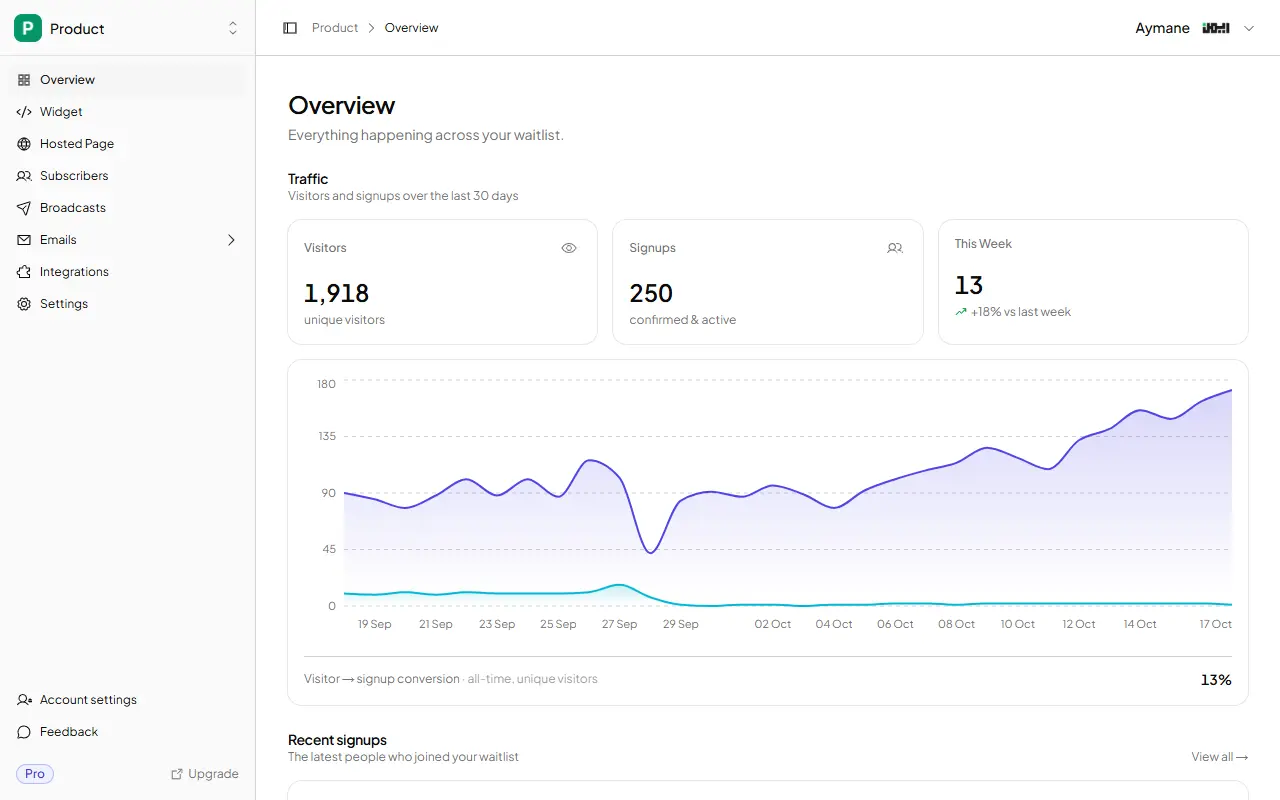
- Collect signups while you build. Free plan covers your first 100 subscribers.
- Warm the list with a sequence. Send a short series before enrollment: welcome, value, proof, then open the doors.
The email side matters as much as the page. See the Waitlist Email Sequence guide for the five emails to send.
The online course launch strategy, week by week
A first course launch usually takes four to six weeks. Here is the shape:
| Week | What you do | The goal |
|---|---|---|
| 1–2 | Open the waitlist, start promoting it | Prove the topic; get your first 20–30 signups |
| 3 | Send value emails, keep promoting | Warm the list; grow toward 100 |
| 4 | Announce the launch date and the founding-member price | Turn interest into commitment |
| 5 | Open enrollment, send the open + close emails | Convert the warm list |
| 6 | Onboard the first cohort, collect feedback | Fuel the next launch |
The weeks overlap, and a smaller list moved sooner beats a bigger list held for months. If you cannot get 100 people on a free list, do not build more course — the topic is the problem, not the marketing.
The minimum viable course launch
You do not need a finished course to launch. You need four things:
- A waitlist page with a clear promise — who it is for and the outcome it delivers.
- One module you can actually deliver if someone buys today.
- A price — even a founding-member discount counts.
- A way to take money — Stripe, or your course platform's checkout.
Everything else — the full curriculum, the polished sales page, the webinar — can come after the first cohort proves people will pay.
Adding it to your course platform
- How to Add a Waitlist to Kajabi — custom code block on your page
- How to Add a Waitlist to Teachable — a custom HTML block
Both take a few minutes and keep the list in GetWaitly until you are ready to import students.
The launch sequence (short version)
- Welcome — confirm they are in, set expectations.
- Value — give one genuinely useful thing before you ask for money.
- Proof — a result, a testimonial, or your own before/after.
- Open — announce enrollment with a clear deadline.
- Close — a final reminder when the window ends.
That is the whole pre-launch. The full breakdown, with subject lines, is in the email sequence guide.
Referrals and founding members
A course launch benefits from word of mouth more than almost any other product. Turning on referrals gives every subscriber a shareable link, and you can reward the top referrers with a founding-member price or bonus module. That turns your waitlist into a small affiliate engine before you even launch.
FAQ
Do I need a waitlist to launch a course?
No, but it is the single best way to avoid launching to an empty room. A waitlist validates demand and gives you a warm audience on day one.
How do I build a course waitlist without a website?
Publish a hosted waitlist page — no website required. If you have a course platform like Kajabi or Teachable, embed the signup form there instead.
When should I start collecting emails?
As early as possible. Start the waitlist before you build the curriculum, so the list grows for weeks while you record.
Should I charge for early access?
Usually no. A free waitlist maximizes signups. Offer founding-member pricing at launch instead — it rewards the list without adding friction up front.
Is it free?
Yes. The free plan includes a hosted page, an embeddable widget, analytics, and up to 100 subscribers. Referrals and broadcasts start at $5/mo.
Related reading
- Waitlist Emails: The 5-Email Sequence — the launch sequence in full
- Waitlist Use Cases: What to Use a Waitlist For — every use case in one place
- Pre-Launch Referral Program Guide — the referral mechanics that work
- Early Access Waitlist: How to Run It in Waves — invite your first cohort in waves
- How to Add a Waitlist to Kajabi — the platform how-to
Build the list before you build the course — free to start. Start your waitlist →

written by
Aymane E.
Founder of GetWaitly. I write about validating ideas, pre-launch, and growth from building a waitlist tool as a solo founder.
Follow on X